Genomics, Molecular Cytogenetics, Chromosomes, Cell and Systems Biology and Genome Organization
Pat Heslop-Harrison and Trude Schwarzacher, Department of Biology, University of Leicester, LE1 7RH UK.
www.molcyt.com E-mail: PHH4(a)le.ac.uk & TS32(a)le.ac.uk Phone: +44/0 116 252 3381; FAX: +44/0 116 252 3330

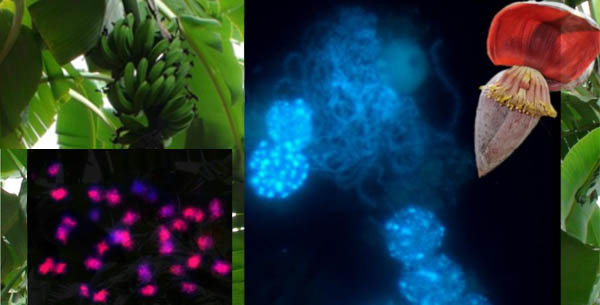
Pat Heslop-Harrison, Trude Schwarzacher and the Molecular Cytogenetics and Plant Cell Biology Group study the biology of the cell nucleus: its spatial and dynamic organisation or architecture, the function and interactions of its components, and the nature, evolution, expression, recombination and segregation of the DNA sequences within the nucleus at interphase, mitosis and meiosis. We look at repetitive DNA and its evolution, with a particular focus on tandemly repeated satellite sequences and retrotransposons. We look at the biodiversity of genes, particularly in crops, and those related to pathology and disease resistance, sustainability and consumer traits, and abiotic stress and have interests in sources and uses of genomic mutations. Key methods include molecular cytogenetics, DNA sequence analysis and systems biology approaches. Taking a comparative genomics approach, we have interlinked projects with a range of different species: a particular focus is on plant crop species (banana, cereals including wheat, rye and barley, brassicas, and cowpea), while important projects include work with Dictyostelium and E. coli, Drosophila, Scallops (Pecten), and bovids.


NEW October 2009 (see News below): Darwin and Chromosomes: Lectures from Brazil -- Biomass QTLs -- Publication List and Abstracts Update

Link to Previous News Stories from this page


Title for talk on Chromosomes and Evolution26th Conference on the Theme of Genetics and Breeding: University of Sao Paulo, Piracicaba, Brazil, October 2009

In an exciting meeting focussing on Darwin, evolution and cytogenetics, Pat Heslop-Harrison presented a talk on "What the chromosomes say about evolution", (link to PDF click here - quite large file) starting with quotations from Darwin and then showing how experimental work with crop species shows chromosome evolution in action. This information is used for crop improvement.

DNA Satellite Evolution

Guto Kuhn reports for the first time interspersion between non-homologous satellite DNA repeats in Drosophila. The article features on the Heredity website for May 2009

Extended DNA fibres from Drosophila nuclei showing junctions between non-homologous satDNA sequencesMolecular analysis of satellite DNA junctions revealed that they have evolved by multiple events of illegitimate recombination with subsequent rounds of unequal crossing-over expanding the copy number of some junctions.

This work also revealed satDNA monomers organized as higher-order repeats – a rarely reported feature in the Drosophila genus. (Link here our other work on Drosophila satellite DNA.)

See full paper at: Kuhn GCS, Teo CH, Schwarzacher T, Heslop-Harrison JS. 2009. Evolutionary dynamics and sites of illegitimate re-combination revealed in the interspersion and sequence junctions of two nonhomologous satellite DNAs in cactophilic Drosophila species. Heredity 102: 453-464. doi: 10.1038/hdy.2009.9.
Colour plate linked here.

Biomass Gene Locations (QTLs) Identified in Ryegrass

QTL for Biomass on Lolium Chromosome 3 Anhalt et al. 2009Olli Anhalt, who completed her PhD working with Susanne Barth at TEAGASC, Ireland, and in Leicester, has identified a major QTL for fresh and dry weight which explains around 30% of the phenotypic
variance in a large field experiment involving 360 F2 plants. The discovery of loci with such huge genetic effects is very important for understanding how to increase yield of grasses and biomass crops more generally. The full results are in: Anhalt UCM, Heslop-Harrison JS, Piepho HP, Byrne S, Barth S. 2009. Quantitative trait loci mapping for biomass yield traits in a Lolium inbred line derived F2 population. Euphytica 170: 99-107. doi: 10.1007/s10681-009-9957-9

(first link needs password, second needs subscription)

A talk on Banana: Past Present and Future was presented to the Warwickshire Womens Institute.

ECA course in Nimes 2009 - Plant Molecular Cytogenetics slides here (11MB large PDF - wait for download).

A paper on "Biology and Engineering: Coming Together in Systems Biology" was presented in Korea (link on title opens 8MB PDF of my talk). Video-on-demand VOD of my talk is at http://www.eimbl.org/club.intro.seminar.list.screen?p_cate=35

A paper on Genomics, Economics and Bananas was presented at the OECD meeting on Tropical Fruits in November 2008 (indirect link).

Related websites: www.SBLab.org for our Systems Biology work.
www.BioAstral.com for our spin-out company involved in hyperspectal quantitative imaging.
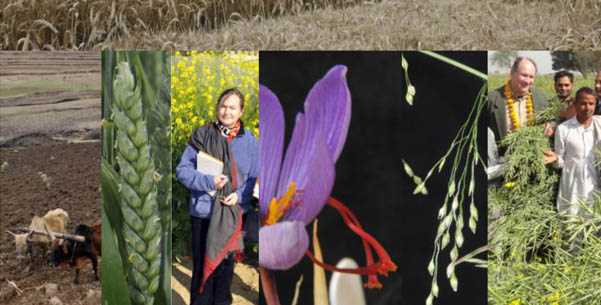
www.CrocusBank.org for information about a new EU project on Saffon Crocus and its relatives

Link to PubMed database and paper downloads (click on 'page' icon next to title).
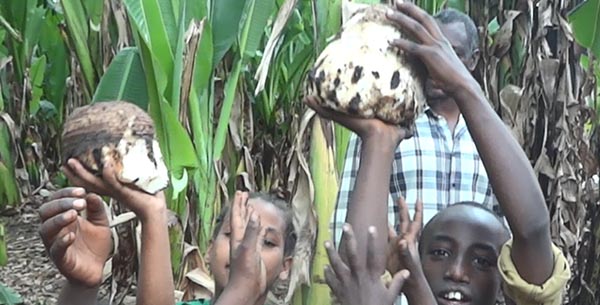
Downloads of recent lectures, including one on banana and genomic sequencing with new preliminary results on heterozygosity, and other information is available from http://biobanana.diinoweb.com/files/ .

The group has four major aims:

Research on the fundamental biology of the genome
Application of research in crops and animals of importance to tropical agriculture
Development of novel technology for biological research
Technology transfer and training in the approaches we use.

Chromosomes with in situ hybridization
Our molecular cytogenetics lab is in the Adrian Building of the University of Leicester. It includes the major wet-lab and informatics areas, with two air conditioned fluorescent microscope rooms, equipment and cold rooms across the hall. This photograph is taken from outside the staff offices.
We use a combination of genetic, molecular and cytological methods - molecular cytogenetics - including in situ hybridization (hybridisation), fluorescence microscopy, electron microscopy, flow cytometry, DNA microarray and oligonucleotide hybridization. supported by development and application of modelling and structural/mathematical techniques as well as molecular biology. Repetitive DNA in the genome is important for evolutionary, genetic, taxonomic and applied studies, providing polymorphic markers. Repetitive sequences include microsatellites or simple sequence repeats, retrotransposons and retroelements, genes, and tandemly repeated elements.

Our work is important in showing the evolution and interaction of the majority of sequences in the genome, and their physical and functional relationships. The unifying aim of our work in terms of fundamental biology is the understanding of the dynamic and functional architecture of the cell nucleus, leading to an integrated structural, physical and functional map of the genome.

A lot of this fundamental work is directed towards applications in biodiversity studies, phylogenetic and evolution, and for uses by plant breeders, particularly in agriculture of subsistence and smallholder farmers. For example, plant breeders need to know about how evolution occurs, the diversity that is available to them, and how genes recombine and are involved in generation of somaclonal variation and functional genomics. Our work with mammals and insects has veterinary and medical implications.

Key areas of our research are:

Large scale organization and evolution of genomes
The function of repetitive DNA sequences,
including those at the centromeres
The evolution of repetitive, tandemly repeated satellite sequences
The assessment of biodiversity in wild and cultivated species
The technology of fluorescence imaging, improving the sensitivity, quantification and discrimination of probes used for
in situ and microarray hybridization
The understanding of the origin, diversity and evolution of agricultural species
The improvement of crop species using novel germplasm, particularly for applications in developing countries
Understanding genome modulation in hybrids and polyploids
The application of mathematical approaches to 1) evolutionary and sequence analysis problems ('bioinformatics') and 2) of systems biology approaches to understand interactions ocurring in the cell - its nucleus and cytoplasm
Understanding genome modulation in hybrids and polyploids
systems biology, Dictyostelium Following the effects of alteration of DNA methylation and DNA protein interactions
Characterizing the nature and behaviour of the centromere and it associated DNA sequences


Cover Practical in situ hybridization book

Practical In situ Hybridization - Schwarzacher & Heslop-Harrison 2000
is available easily from Amazon.co.uk (second hand only from Amazon.com).


Price Euro€/US$70, GBP£38, JPY10,500

Buy this book from amazon


Ears of wheat species oil palm chromosomes probed with telomeric sequence and NOR probe Arabidopsis centromeric sequence

The current projects are within the University of Leicester. As part of cell biology, our interests include the RNA and proteins located within the nucleus, and their temporal and spatial relationships. We take a comparative approach to genome analysis, investigating many different species to find universal and species-specific features of genome organization. In animals, we work with the Bovideae, rodents and some insects. Within plants, we work with the Gramineae (wheat, rye, barley), Chenopodiaceae (sugar beet), Palmae (oil palm), Pinaceae (pine, spruce), Leguminoseae, Iridacae (Crocus), Cruciferae (Brassica and Arabidopsis), Musaceae (banana). In systems biology, we use Dictyostelium models.

Pat Heslop-Harrison is Professor of Molecular Cytogenetics and Cell Biology at the University of Leicester. His interests include genetic diversity, crop evolution and breeding. Pat Heslop-Harrison moved from the Karyobiology Group, John Innes Centre, Norwich UK in October 2000. Trude Schwarzacher is Lecturer in Molecular cytogenetics in the University of Leicester. She moved from the Cereals Department, John Innes Centre in January 2001.

To assist indexing programmes, this home page is designed to be key-word rich, and variant spellings are used (e.g. organization/organisation, labelling/labeling, hybridization/hybidisation).

www.molcyt.com - index.htm